
THE NEXT MEAL
new fiction by Rupe Nestor
THE NEXT MEAL
A small fish was their sustenance that week, together with a few bites from the last lumps of pemmican. They no longer noticed the burlap threads amongst the fat and oats. Food was food. Crozier, who would become timeless, slit open the belly, hands shaking from chill and hunger. He used an embossed dessert spoon to wedge open the firm pink flesh and artfully scrape out the meager innards. The vertebrae nubbed together in the stunted growth of lean years.
Hickey watched solemnly, as Crozier ate both eyes himself, sucking them out with a swift pucker. The head, the sockets, he handed to Hickey.
Later, they met a man out on the ice. Landscape all white. Light white, dark white, shadowy, reflective white. No caribou yet, the esquimaux man had signed. It is summer. Crozier had laughed. Summer! With ever-frozen fingers and stiff black lips we talk of summer. Crozier, who hated being on the back foot, did not look at his companion for fear any emotion would break them down into vales of tears and bones. They would become the long puddles in the permafrost: never drying, never dying. A winter-summer, yes, signed the man. When there is much fallen snow floating on water. Out here on the ice-flat puddle-land they could all understand each other.
There was nothing else to say. Behind them spread the jagged curve of the river inlet, encrusted with sea ice. The man, who was from the people who carved pots, carried a heavy sack. Crozier, who was always curious, motioned to have a look. Soapstone, in large pieces.
Leaving, the man placed two of the stone pieces on the hull of the boat. In exchange, he took two dessert spoons, opening the leather box where they lay in cranberry velvet and inspecting each object before selecting his barter. He signed of something to come between these two pale men, an unravelling. Then he trudged away without looking back.
(Later, in the winter-winter when Crozier appeared alone on the edges of Qamani’tuaq, hoping to be invited in, this man of the soapstone-for-spoons trade looked right through him. Even years on, when Crozier had become the white man who lived amongst the esquimaux, the man from the river inlet never spoke to him. When they passed each other in the town, it seemed to Crozier that the man was looking at the space where Hickey would have been.)
When the weakness became too much, Crozier, began preparations. Perhaps he had always known it would come to this. He may have known when he selected Hickey, gullible as the day was temporal, as his companion for the journey. Crozier located the cracked soapstone pot they had taken from the fishing site by the mouth of the river. The great fish river, in which the white men had never seen any fish. With a few pages from his diary and a hunk of wood from under the lip of the boat, he started a fire. The pot was thick-walled and marked with a crack. The water leaked slowly out one side of the pot while it boiled on the other.
Hickey had followed Crozier faithfully. Now he lay on his side in the boat breathing shallowly, hunger weakening his lungs. Crozier did not want blood in the boat. The boat was all the stumbling men had left from the ship. So he hauled Hickey out. The day before the act this would have taken all his strength. Now an energy was coursing through Crozier. Crozier, who was usually equable, was breathing like a beast. A meal was coming. Within grasp. His blood rose. His body throbbed. He could only imagine satiation. He was hungry and ready to eat.
Crozier dropped Hickey on the hard pack snow and felt strong like a young man. He tipped his shipmate away from him. Not to see the eyes when they go out. What could have been a swift slit back on the ship, where there were sharpening stones and a galley of knives, out here on the snow became a mess. Hickey mumbled as his companion sawed through skin to artery. The dark liquid warm and strange in all this coldness and white. All the way to bone.
Crozier popped the too-large pieces of muscle into the too-small pot. The meat on the bones was lean, after all these years of rationing. Still, it was the meal Crozier needed. His blood surged. Only the now was here. Only the here was now. A quiet took over and heightened the senses. This moment of feeding the body, nourishing the need. This was living. This was all there was.
Crozier, whose descendants would follow in his footsteps, sat back after eating. He did not survey the scene. The moment was gone. Sublimity does not run in reverse. He left it behind and continued onwards. Soon, the hunger would return.
Alone it would be too hard to pull the boat, he realised. They had drug this boat across the ice from where the ships had frozen in. At least six days of pulling and heaving to keep this last vestige of civilisation near them. This outrigger boat filled with items from home. Now, parting from the boat was a sudden sorrow, a well of sentiment Crozier was unprepared for. In a flurry, he grabbed a brass button off the jacket Hickey wore. Not Hickey’s own but another’s. Inherited or stolen. A man who left this world in the clothes of another. A man who left this world through the appetite of another. A brass button leftover. Crozier pocketed it. In the calm after his frenzy, he wondered at himself.
To be fair, the situation had deteriorated gradually. He could be forgiven for not noticing how unravel had crept in, closer and closer to the heart of the matter. Ruin crept in all the way to the brass buttons that the officers wore up and down their chests. Chests which, once proud and filled with the importance of being abroad, started to cave in. The men became shades of their former selves. Concave, diminutive, skeletal.
This was not what he had signed up for. Joining the navy, Crozier, who was eleventh in the family line, had landed in adventure. He had been part of expeditions into great unknowns. He had become an expert on magnetism. He had stayed up nights under open skies mastering this science. He knew the modern methods for calculating magnetism better than anyone. Crozier, who was of humble origins, never got his due though. It was always the others who received the congratulations, the soft men who had dropped undeserving into the bastion of leadership. Glory he could take or leave. To do something interesting was enough. Now though, the last man standing from two ships, passed three winters locked in the sweeping ice, he would follow no other man. Now he sat alone. Looking out at the white. Snow floating on water. Snow that blows off the underside of the mast of the ship that cannot sail.
If only I had seen, Crozier wrote in his diary, what had needed to be done. Tins spoiled. It would be fish and seals or nothing. We are too far from the caribou and our rifles are in poor working order. It had become too late. Now their fate was to consume each other or to sink into the deep blue waters, hovering just above the freezing point.
What became of these diary pages? Did they accompany Crozier on his slow trek over land, to the village of Qamani’tuaq? Time unravelled the words. Only the soapstone pot and the brass button carried onwards. Crozier saw Hickey and the other perished men only in dreams.
* * *
A child was born in Qamani’tuaq and the family continued. These Croziers with the hunger inside. Through the decades they walked and rode across the white landscape. On snowshoes or horseback or snowmobile. Always seeking, always needed, plying towards that which excites the blood.
Once the hunger is unleashed there is no putting it back. Something begun cannot be reversed. The thrill of giving way. Beasts traversing the lands, Too hungry to die.
The lived as fur trappers, scouting virulently for mustelidae in the spindly forests, or spent their days as loggers, felling trunks, or as railroad engineers, laying pathways of metal. Over time, their pursuits became tamer. The railroads had all been connected, the trees had all been shipped. As safety became a commodity, the escapades of these descendants became minute. The twenty-first century dawned, leaving their wild needs stranded.
A man walks with certainty across the white landscape in pursuit of the next moment. A thousand near misses. Too hungry to die. On towards the next adrenalin.
On a frozen river inlet, a cracked soapstone pot waits to be filled.
* * *
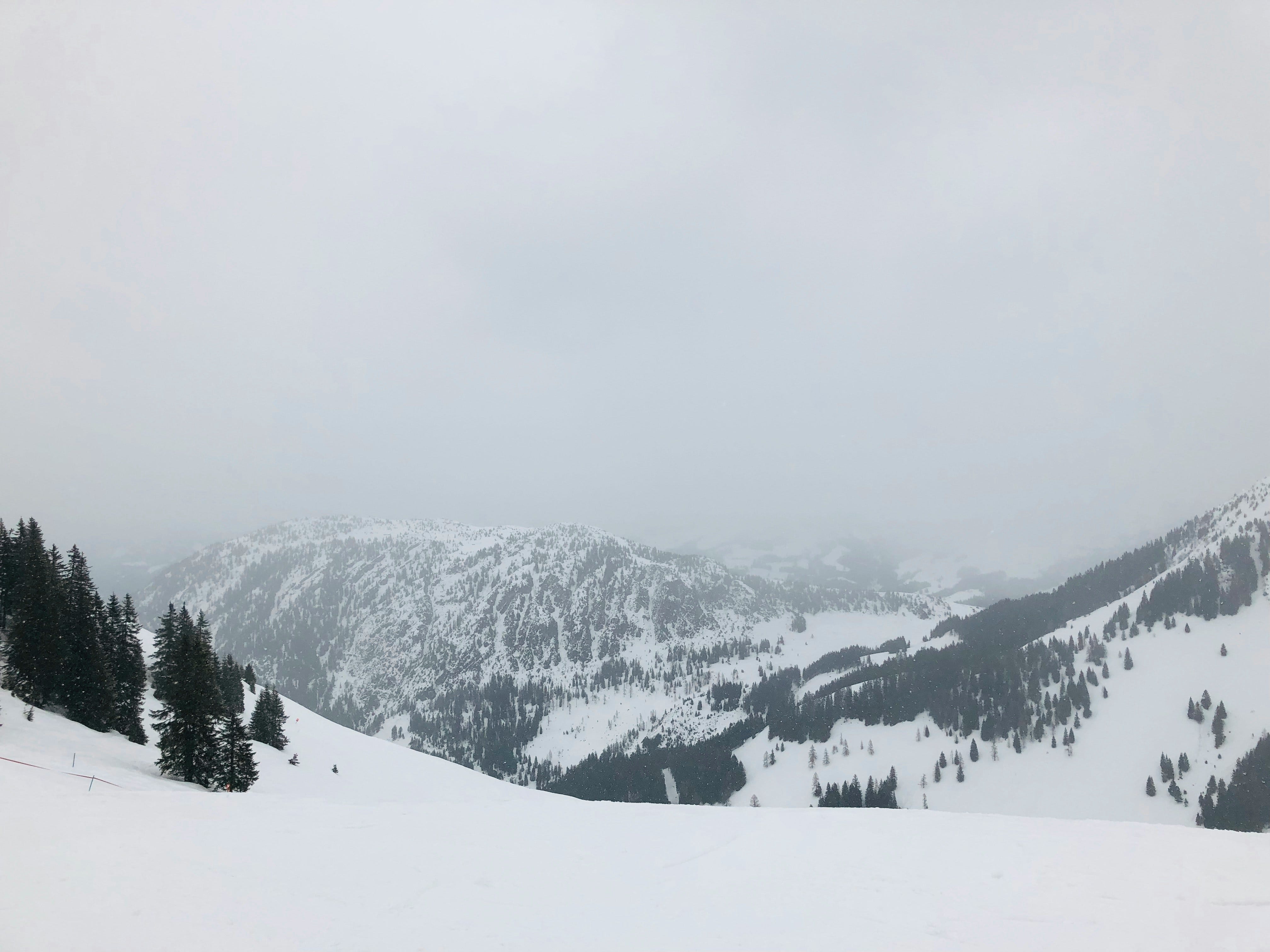
Two young men stamped their way up a mountainside. The freshly fallen snow came up to their thighs, light and airy. The type of snow that sits in trees and never melts. The man in front, Brody who had no fear, could see the top of the rise. Deep blue sky against shimmering snows. Mountain tops jagged in the distance. The kind of snow that blankets the land.
The two men climbed this section of the mountain often. Brody had even skied Crows’ Cliff and lived to tell. Now they stood together, surveying the terrain. They pointed out runs of clean snow to try and access. The snow field near the gully, or the long white strip on the north-east side of Poet’s Peak, opening tantalisingly into a wide meadow of powder. A conversation the young men had spoken at this location a thousand times.
They talked of simple things while they suited up. Of other things. It was uncouth to talk about the act right before the act. That ruined the moment. Small talk while they clipped into skis, tightened backpacks. Poles in hand. Goggles down.
Then they were ready. Blood surging. Body tingling. Alert. The slope fell away as the men started downwards. Dropping weightless. Their skis hitting the ground softly, slicing through the snow, feathery and weightless. The type of snow that flies away. Knees, hips, arms in synchronicity, obeying without thinking. Focus like a laser. A quiet taking over. Heightening the senses. No cares beyond the next turn. No purpose beyond the next shot of snow dust in the face. Only the here was now. Only the now was here.
If only the moment could have lasted longer. It was always over so quickly. At the bottom of the hill the two friends chatted to prolong the moment. As the memory of the run faded they talked of the next exploit. Brody was hungry again by the time they reached the truck.
Later that evening, they sprawled around their rented living room. New carpet, which smelled of factory. Old couches handed down from siblings or friends. Brody and his friends were no longer students but they had no intention of joining the office world. They lived to ski. In summer, to bike. Work as little as you can and only spend money on what you care about.
A television hummed in the background on low volume. The men working out the goal for the next day. Two young women on the couch, talking in their own world. These conversations ebbing and falling in a soft symphony around the room. The men spoke of technical details. Jackson, head down and rolling a joint, dismissed the idea that they needed the right wax for the undersides of their skis. To Jackson, wax was wax. It all got you down the hill the same way.
Brody, who missed all irony, could not abide by that logic. He leaned back to explain. They manufacture these waxes in totally different conditions. The technology itself differs according to what temperature the wax is for. That was why the blue wax was best for powder. Not just best: necessary. Otherwise, things became unsatisfying. Brody who fixated on what he knew, stated his opinions as truths.
After smoking the joint, Brody gave up trying to explain. It was not his fault if others missed obvious ideas. A good thing could be so much better when you pushed it further. Too bad for them if his friends could not see. What a waste, to ski fresh powder with the wrong kind of wax. Fresh powder was a very specific temperature. You needed blue wax for those conditions.
And my grandma needs a different colour of undies to remember the days of the week, Jackson laughed at his own joke.
Tipping his head upwards from his sprawl on the sagging couch, Brody became entranced by the cream-white ceiling, its texture like shades of snow. That slope across the valley looked the same. Broad blocks of white cut with shade. In his mind, Brody left the living room. He flew through a world of white and air. Power on your face. The type of snow that invites. The moment he was always hungry for. Brody came out of his reverie, grinning with the wisdom of the young.
The women on the couch spoke of other things entirely. They did not listen to the men. Brody left the room in search of blue wax. He strode out purposefully.
Was he going to get dinner? One of the women pulled out of the couch conversation to ask aloud. The woman sharing the couch stopped her knitting and laughed. Brody? Get dinner? Have you met him? Jackson nodded a half-smile. Brody only does what he wants.
The three came together in soft chatter, with the television completing the sonata. From the garage, Brody’s music rose and fell in minor conflict with living room soundscape. He had found the blue, tucked away in a neatly-labelled box, and was now waxing his skis lovingly. Preparing for the runs of tomorrow.
But early the next morning, before the young men could head out to the mountains: a phone call.
Mom is dead. Brody held the phone casually, trying to place his sister’s voice. She sounded foreign. Turn off the music Brody. Angry on the other end of the line. Mom died last night. You need to come home.
Home, thought Brody absently. He tried think, tried to imagine the house he had grown up in, but all he could see was that soft, untouched line of snow. The type of snow that beckons in the sun. Why had this phone call come today of all days? When they were finally going to bag Poet’s Peak. When the snow was waiting for them. But even Brody, who disregarded everyone and still kept a retinue of friends, was not above the tide of events. By that evening his sister was collecting him at the one-gate airport in his hometown.
Brody had been sent up to the attic to try and make sense of its contents. His sister came into the room and tried to hug her brother but Brody ignored her attempts. She was a nurse and wanted to comfort everyone she saw. She was intent on making things better but he didn’t need any help.
He sat on the cedar floor planks, the contents of a box strewn around him. A mish-mash of items, not used during their parents’ lives and thus unrecognisable to either Brody or his sister. He held up a brass button. Hmm, his sister was distracted. Just sort the boxes, willya. She moved off to ameliorate the next problem. Brody looked at the button again. It looked old.
He unfolded a drawing that had enveloped the button. The drawing was lightly etched and quite faded. Done with a skilled hand, it was a drawing of a pot. Thick walls, with a crack all the way down one side. What type of pot cracked like that? Who drew this?
His mom had been an artist, a painter and a poet, though Brody never read any of her work. Boring stuff written for women about their uneventful lives. She had drawn sometimes though, Brody remembered. Perhaps she had sketched this stone pot but maybe not. The paper looked old.
He could not catch his sister’s interest with these items. That possibility had passed them both by years ago. A sigh from her. Just go home Brody. Just go play your Xbox or whatever you do up there in the mountains all the time. Messes needed to be remedied and Brody was simply adding to the disorder. She brought him back to the airport that evening, indifferent to the brass button in his pocket.
A thousand texts from Jackson later, Brody returned. He could see it all in his mind. Worked out with Jackson while away. They would go on Friday. Poet’s Peak. The open slope they had admired for years. It would be theirs. The idea excited Brody to distraction. They would leave early. Hit the run just as the sun rose. The moment would be perfect.
He landed on a Tuesday. Days to wait. Brody, who never worked, tried to fill his time. He rewaxed his skis. He cleaned out the bed of his truck to a spotless standard. Could have cooked a steak on it and lived to tell. He found Nicole amidst her knitting and slept with her. From her bed, Brody texted Jackson. Jackson worked and could not always respond promptly. Brody brooded alone.
On Thursday, Brody could not wait anymore. He drove up to the usual spot by himself, just to grab a quick morning run. When there, he did not suit up immediately. He sat down on a large rock and turned all his attention to that strip of unblemished snow across the valley. God, how beautiful. Tomorrow it would be his.
A tremor passed through and his blood cooled. He looked closer and squinted to see. There, right in the middle of the run, was a cliff, nearly invisible under thick snow. The type of snow that covers cliffs. Staring at this unwanted detail, Brody, who loved action more than thoughts, felt something happening. There was something about this cliff. It reminded him of something. The pot from the drawing. A prominent crack running all the way down one side. For a whole entire moment, he did not know what to think. Perhaps he was hallucinating. So he shook off the sensation and clipped into his skis for the run.
Must tell Jackson, that we have to stick to the east side of the route. Away from that strange, cracked cliff. But the shadows on the snow were different around cliff; they were darker. That would be enough to tell where not to go.
Finally, after thousands of conversations about it, the young men stood at the top of the untouched strip of snow. Just as hoped, the sun was rising. The snow crystals caught the light, sparkling. Seven inches had fallen fresh last night. Too good to be true. Everything stacked up for the perfect moment.
Brody, who was usually equable, had jangling nerves. For a split second he wondered about it. Where did this hunger come from? Had he always been this way? The drive seemed to own him and he considered briefly what was in control of what.
(Later, Brody would arrive afresh in a new ski town and settle in. Although arriving alone, he would quickly attract a coterie. Once he would see think he saw Nicole from a distance and duck instinctively backwards into a bar, afraid that she would look ask aloud where Jackson was.)
Jackson was nervous too. He wanted to hike down first and check for hazards. Brody explained that would ruin the perfect line. They had been waiting for this slope for so long. It had to be untouched. Had to be perfect. Jackson acquiesced.
They started the run, Brody in front. This was the moment they had been waiting for. Brody’s body trembled. His senses opened full and the slope blanketed out all distractions. He made his way down the first section of snow. The meadow rising and falling in his view as he turned his body side to side without thinking. The body needs the moment and the moment needs the body. The meal was served, gliding down towards the open patch of perfect snow.
The meadow met his skis with poise. Perfect puffs of snow shot up from underneath. The type of snow that jumps and explodes. The rush was all Brody could feel. This was it. This was what he lived for. It was everything he had ever wanted. His knees pumped without effort. His blood surged as he floated over the spotless meadow. This is what he had been born for. The subliminal moment.
At the bottom of the first slope, Brody let out a whoop that shook snow out of the trees. He looked back to celebrate with Jackson, but his friend was not there. The landscape was empty except for the dark, cracked cliff, sharply visible from the bottom of the meadow.
The cliff. Brody had forgotten. He had meant to say something.
He thought he could see Jackson’s ski sticking up from snow where it met the stone of the cliff. The type of snow that holds skis upright. What a pain, he thought, and right in the middle of this perfect run. They had been waiting ages to ski this meadow. If Brody walked back up to check on him, he would interrupt the moment. And there was a whole other section of the meadow to ski yet. Surely Jackson would follow soon and tonight they would laugh about Brody’s oversight.
Brody, who needed the thrill above all else, turned his body and pushed off downwards through the powder. If possible, it felt even lighter down here. As though it were getting more perfect as the run continued. This was living. This was the hunger satiated. He finished the run and drove home alone, forgetting that he was meant to wait for anyone. His friend, left behind, troubled him only occasionally in dreams.
Rupe Nestor has been writing all her life and, having recently realised that building readership is awesome, is excited about getting her work out there. Although she loves all forms of prose, the books she first fell for were 19th century novels. Rupe is currently into kitchen choreography and taking her compost bucket on walks. She prefers vagabonding to sedentary life. You can find her online at Linktree and Substack.

This story is written in black and white, not Kodachrome like everything else. Loved it.