Tabula Rasa by Amy Kitcher, reviewed by Shoshana Groom

Review: “Tabula Rasa,” by Amy Kitcher
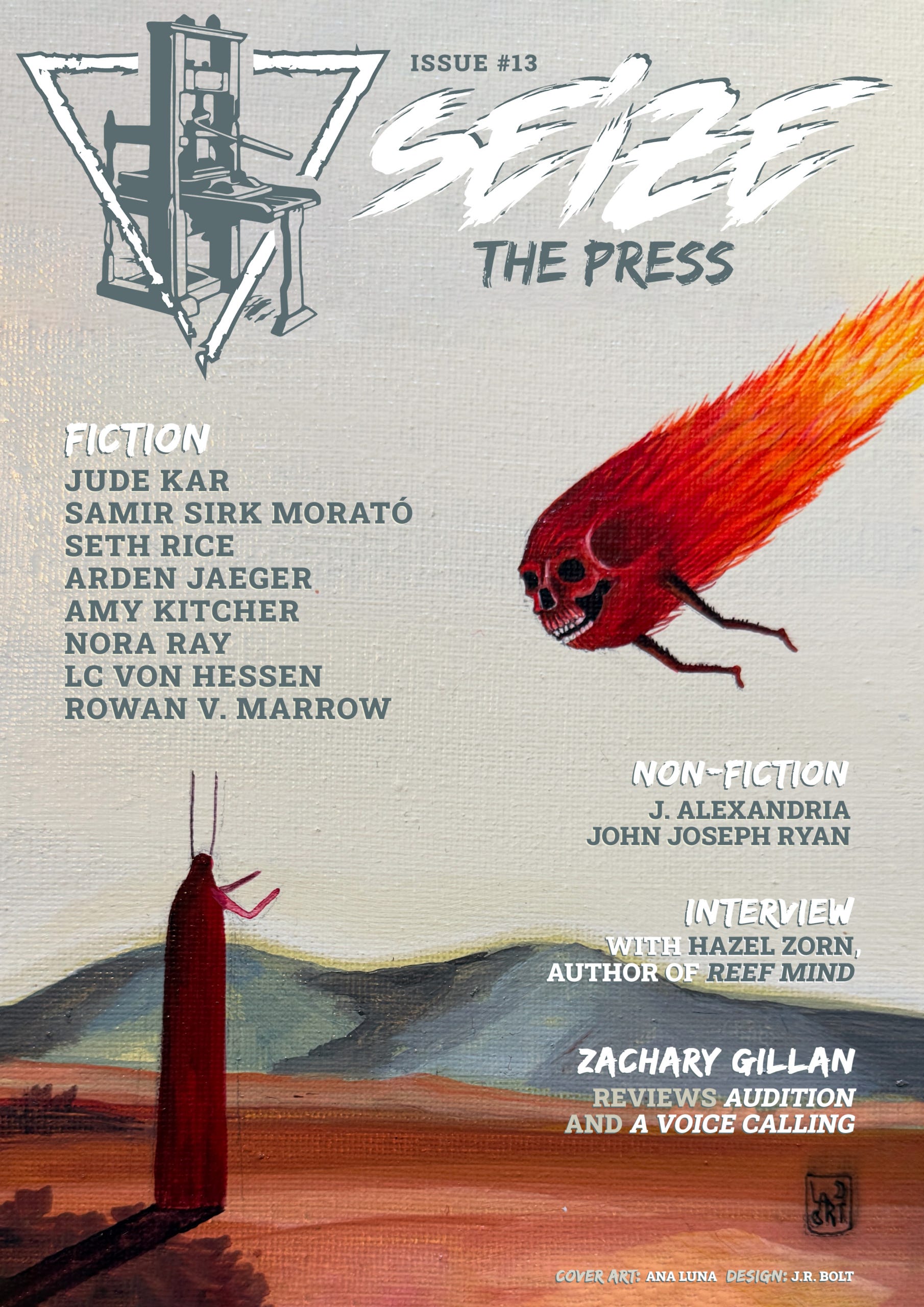
“Tabula Rasa” by Amy Kitcher, published in Seize the Press’ 13th issue, is a beautifully-written and horrifically visceral short story that makes for an evocative read but leaves you with little after. It takes place on Earth in the near future, and is situated in the POV of an impoverished lunar alien using us/we pronouns who is economically forced into sex work. After a detailed alien-human sex-work scene, we learn about the torture and abuse of the aliens at the hands of humans, and we end the story with the discovery that the lunar aliens have concocted a plague to justifiably wipe out the human species. Oh, and there’s an ongoing theme of penises.
The meat of the story is the worldbuilding; the actions of the characters are means to communicate the backstory and setting, and neither these actions nor the characters are notable in and of themselves. The main character is just one of many lunar aliens forced into sex work and seeding the destruction of humanity, and nothing is particularly special about their (‘their’ being a plural pronoun in this case, and not a non-gendered singular pronoun) client or the sex he paid for. In this way, “Tabula Rasa” feels more like a concept than an actual story, but the concept is communicated well. The sex-work scene is detailed enough to make me physically uncomfortable (so many tentacles), and to firmly establish the empty debasement the lunar aliens have been subjected to, and the descriptions of torture left me squirming: “They injected dyes that made us muscles seize and foam. They scraped us skin for fungal cultures, swabbed us eyes with dry gauze until they bled. They dissected us dignity along with us flesh, catalogued us pain like data points.” It’s hard to read, but the impact of these words left a lingering feeling of ants on my skin, and for that, I tip my hat to Kitcher.
The penis theme strings the story together, and it comes to a surprisingly robust head (sorry) at the end. A marker of thoughtless domination, it symbolizes both strength and disregard, a spray-painted wall that’s turned into a crude joke and a flashing sign over a brothel announcing that the souls inside are for sale. As the story progresses, the theme is turned on its head to symbolize fragile masculinity, a bravado that’s unearned and will soon bite the conqueror in the balls. Phallic imagery keeps the story thumping along at an even pace, and gives it that nice “Aww yeah, everything’s coming together” moment at the end.
But for all its beauty and—clearly—skilled authorship, the story lacks anything new to say. It’s a story about a unilaterally bad group, and the happy ending is their genocide. Defining a problem, like a species’ domination and subjugation of others, is easy—resolving it is harder, and ‘kill everything that moves’ is a lazy ending. X is bad —-> Kill X —-> Celebrate! is a plot formula that’s so commonly used it’s almost muscle memory, and it works for action flicks where the details of the violence are the point, but for the final reveal in a literary story? I would have loved something that required more effort.
The unilateral condemnation of humanity is also weak, and I expected more from a radically progressive, anticapitalist magazine like Seize the Press. There is no progressive movement that doesn’t rely on the goodness of the people who make it; if we think humans are fundamentally evil, what’s the point in trying? How can we come together to stand up for our neighbors if we think our neighbors aren’t worth saving? It’s easy to wallow in self-indulgent self-hatred for our species (or our race, or our gender, or…), but while it may make us feel like “one of the good ones,” it doesn’t really accomplish anything, which was my sentiment towards the story by the time I read the final word.
So I suppose my review of “Tabula Rasa” depends on what you, the reader, want to get out of your anticapitalist fiction. If you’re looking for strong writing that can carry you into a life you’ve never conceptualized before, this story stands strong. For all my criticism, I truly am impressed with Amy Kitcher—her ability to translate words on a page into a feeling inside of me feels like sorcery, and her mastery of the pen is unquestionable. But if you’re looking for writing that deepens your understanding of the injustices around you and moves you to action, you’d best go on the hunt for a story with a little more nuance.
Shoshana is a writer of folksy, feminist, and fantastical stories hailing from the Willamette Valley. Her work has appeared in Beneath Ceaseless Skies, Maudlin House, and 45th Parallel, among other publications. When she’s not writing, she’s hiking and trying to convince the neighborhood cats to like her. You can visit Shoshana at https://www.shoshanawrites.net/