DING DONG! THE DICK IS DEAD!
Alexandra Naughton reviews Luke B. Goebel's dark and zooted out KILL DICK


2016. Was it the beginning of the end? Or the end of the beginning?
One could argue that there’s never been a time where life felt “normal” or “good” but that’s not really an argument I’m trying to examine in this book review.
There was a shift in 2016. We no longer have 2016-era of woke where we cancel people for liking the wrong movie character. We have woke 2.0, which is more aggressive and less politically correct, perhaps as a course correction in response to far-right podcasters like Nick Fuentes and Myron Gaines who have made it clear that White nationalism is now employing DEI. A lot has happened in the past ten years. Leftist socialism has become mainstream. Bernie Sanders has once again been proven to have been correct too early. Jeffrey Epstein’s victims are getting closer to (hopefully) receiving justice. People are somehow more connected thanks to advances in technology while also being more disconnected than ever thanks to advances in technology.
At the start of 2026, an Instagram trend encouraged users to share photos from their timeline from the year 2016, to show how much they’ve changed aesthetically, intellectually, etc, (and probably to also help train some new artificial intelligence). Instagram has no archive function, and the only way to find your old photos is to scroll back in time through your grid, holding the down arrow. Participating in this trend forced us to long scroll into the past. We are all looking back.
“...don’t look back. Yet time is an arrow and life a story understood only in reverse, and if that story can only be understood in retrospect, why not look back?” pg 75
“The art of viewing ourselves.” pg 77
Kill Dick, the new novel by Luke B. Goebel (Luke Likes Glue) published last month by Red Hen Press, brings us back to a semi-fictional 2016 that asks what if?, weaving together the opioid crisis and the business of addiction, a secret society who secretly controls the world, the rise of “the orange candidate,” and a series of grisly murders committed by “the pain killer” which may or may not have been concocted as a false flag to influence the world stage. Goebel connects everything, with a dark and piquing sense of humor, through the lens of capitalism, altered states, philosophy, and experiential distractions.
Who is consuming? Who is being consumed? Who has the answer? Who will save us?
“Americans hate freedom. They like product.” pg 76
Our main unreliable narrator and hero is Susie, slipping between first person and omniscient third person where she feels more comfortable. Throughout Kill Dick, we get glimpses of Susie in her present state, sober and in a recovery program, recalling the events of the Fall of 2016 with a careful detachment.
“Pills were a choice. Still, society was fucked.” pg 57
After finding her college roommate’s dead overdosed body, she is yanked out of NYU and back to Brentwood by her wealthy parents where she lounges poolside, drooling in apathy toward her own lack of creativity. She’s an artist with a point of view that she is unable to actualize, so she paints flowers. Or thinks about painting flowers.
“To be a killer, to be an artist, to be the Orange President, to be an influencer, that’s all the same game… Explore…exploit…it all depends on what’s inside. Myself, I am a mix, a velvet fist in a steel glove. What else can you be if you’re going to survive this world?” pg 77
Our other main character, Phil, is a trust fund kid in his late 30s. After losing his English lecturer job at NYU, he moves West to start fresh and opens a questionably ethical rehab center, funded by pharmaceutical CEO Dick Sickler (a fictional version of Dick Sackler, the real life OxyContin maker and creator of the opioid epidemic, rightfully portrayed in Kill Dick as a tedious scumbag), pushing Oxy to the drug-addicted unhoused in order to find Peter, his doped out twin brother he believes is somewhere out there on Skid Row. Any good intentions he has are completely lost in the sauce.
“If only he were famous, or talented, or passionate about anything other than his mostly poorly-articulated outrage.” pg 48
“He wanted to do something to help change the fucked up world. Was that because he just wanted to be in charge himself?” pg 87
These feelings of powerlessness are perhaps the catalyst for Phil joining a secret society strictly for the upper echelon, where he finds himself entangled with, and doing the bidding for, a legion of billionaires who use each other and control the masses with a lack of care for individual lives like children stomping on ant hills.
“The Church.. Worked at the higher levels of the organization to influence ‘consensual reality’ by staging ‘plays’ enacted out of real-life events. These enactments appeared to happen by chance, but they were purposefully planned to shift public consciousness.” pg 108
“This is plastictown. Be moldable. The people you’re trying to save, they’re loser versions of yourself, help them quickly and toss them aside.” pg 90
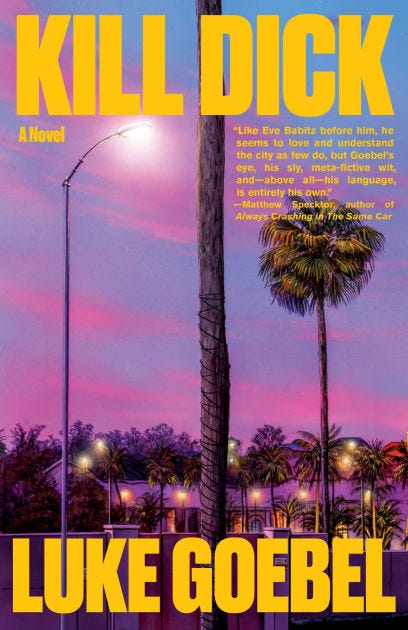
Kill Dick highlights a number of interesting things about the parasitic capital class. How the powerful consumes the disempowered. The drastic mesures people in power will take in order to stay in power, such as poisoning an Emmy’s after party with ipecac and rolling the body of a dead homeless man out on the red carpet to distract the public from any potentally positive press for a documentary about OxyContin killing people.
Despite switching narrators throughout the book, between Susie, Phil, Peter, and Phil’s assistant/Susie’s dealer Royal-Lee, we don’t really get to see this world from the perspective of someone with no lifeline. The closest we get is the queer and racially ambiguous Royal-Lee, who escaped his lower class upbringing and his Jehovah’s Witness devout mother. They’re an interesting character I wish we had spent more time with.
Susie is just as addicted as her unhoused peers, but her class status affords her to opt out of suffering in the same way.
Susie’s father, an attorney whose only client is OxyContin developer Dick Sickler, built his wealth by helping the American public get addicted to his client’s drugs and keeping his client out of prison for lying about how addictive his product is. He gives his daughter an ultimatum:
“You’re going to rehab…Or you can forget about your inheritance!”
“Fuck you, Dad. It’s your junk. And I’m not on it!” pg 120
After Susie’s oxy abuse serendipitously lands her in Phil’s scammy rehab, she takes a day trip to downtown LA’s Skid Row to help recruit new patients. There she is suddenly able to channel her artistic vision into a physical showcase. By signing her name in gold paint on the makeshift tent housing in the open air drug market where real addicts live,
“If the right name were placed on these tents, they’d be masterpieces.” pg 206
she is fetishizing their realness, exploring and exploiting, and capitalizing on their difference from her luxury designer brand lifestyle.
“Skid Row was like a shitty Coachella for junkies and tweakers, a festival that never ended with no musical acts, no selfie-ing brats, no twenty dollar avocado toast. But it felt like real art. Real creativity. A world uncorrupted by the Internet. No corporate greed. Just humanity, plain and simple. No waste. No vanity.” pg 198
“Skid Row was the most honest place I’d ever seen…I felt I was walking among the angels here, souls far purer than anyone I’d ever known.” pg 205
Phil had a similar reaction when he first encountered the drug adled residents of downtown Los Angeles.
“They were more human than the humans. They hadn’t become technology like everyone else.” pg 49
Consume or be consumed. Explore or exploit.
The epigraph page of Kill Dick consists of three quotes. One from the film The Wizard of Oz, and two from the book The Wonderful Wizard of Oz. I didn’t notice this page until after I had finished the book. Obvious reference to poppies aside, the novel truly is a kind of Wizard of Oz/Less Than Zero mashup, with a dash of Manson family folklore thrown in.
Even though we only see him in action on a few pages, the villainous Dick Sickler looms heavily over every pill popped, every overdose, every shit spackled shelter, and every bizarre murder, like the Wicked Witch watching over her victims from her crystal ball.
Sing it high. Sing it low. Ding dong the wicked Dick is dead.
Alexandra Naughton is the editor in chief of Be About It Press. She writes talk about it and has been published widely in print and online. Her latest poetry collection is Sick of Being Inside Myself, from House of Vlad Press.